

 Login / Register
  CATEGORIES
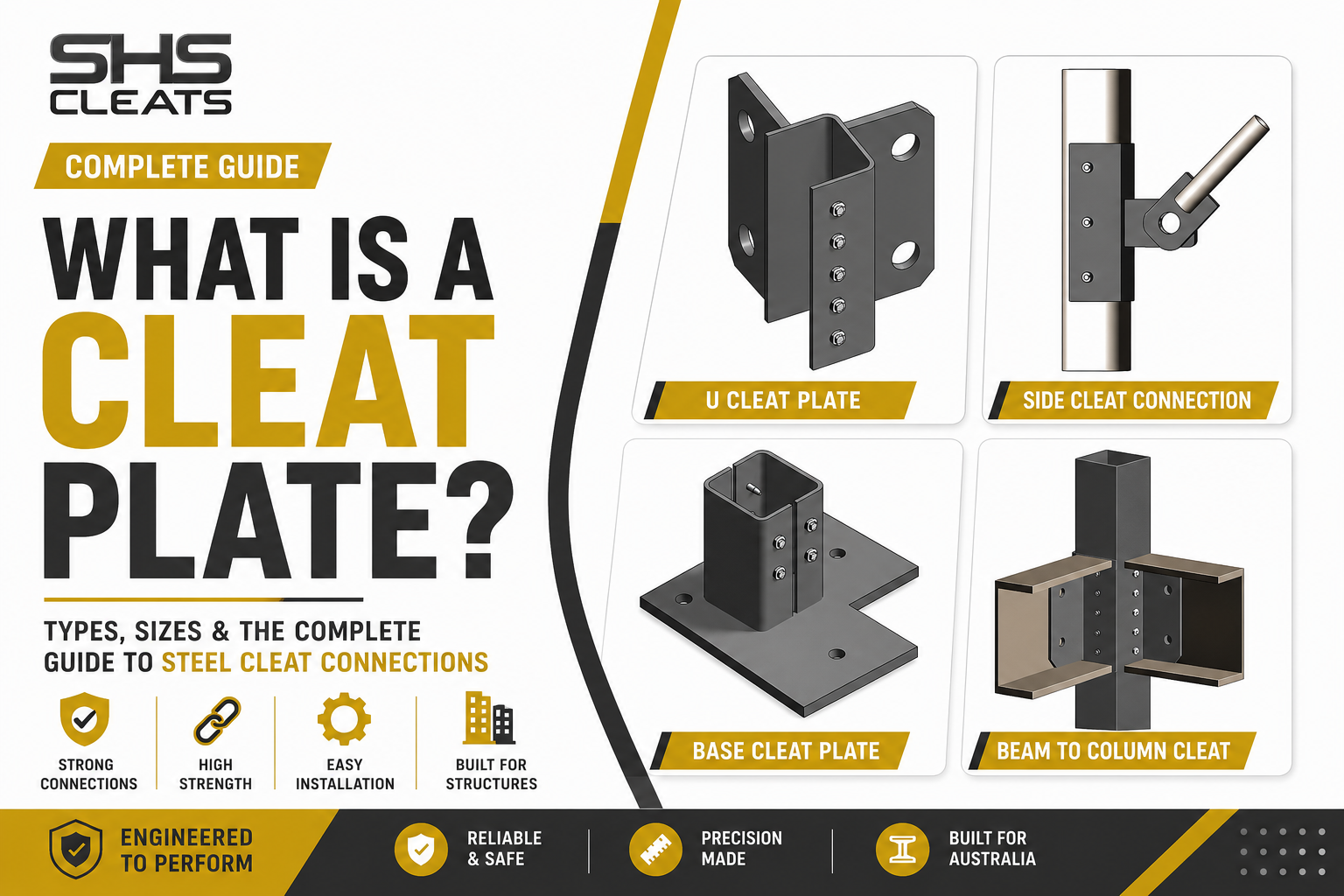
When you’re connecting beams to steel columns on site, the piece of hardware doing that job is called a cleat plate. If you’ve read an engineering spec, asked a steel supplier, or tried to work out what this part is actually called, you’ve probably encountered several names — cleat plate, angle cleat, cleat angle, beam cleat — and wondered whether they’re the same thing.
They’re related but not identical. This guide covers exactly what a cleat plate is, how it differs from an angle cleat, the standard sizes used in Australian construction, how the connection works under load, and why sliding SHS channel cleats have replaced traditional welded cleat plates on most residential and light commercial projects.
What is a cleat plate?
A cleat plate is a steel plate or bracket that connects a structural beam to a column. In its simplest form, a cleat plate is a flat steel plate welded or bolted to the face of a column — the beam end then bears against it and is fastened through it.
The word cleat in construction refers to any connecting piece that attaches one structural member to another. It comes from the nautical use of cleats — the horn-shaped fittings used to secure ropes — and in structural steel it describes any connection bracket that transfers load between elements.
The cleat plate’s job is to carry shear force — the downward load from the beam — into the column. When a floor joist, roof beam, or verandah rafter carries a load, that load has to travel through the connection point and into the vertical post. The cleat plate is where that transfer happens.
Types of cleat plates and steel cleats
Not all cleat plates work the same way or look the same. Here are the main types you’ll encounter in Australian construction:
Flat cleat plate
The most basic form — a rectangular steel plate welded or bolted flat to the face of a column, with holes for the beam fasteners. Used in heavier structural connections where the plate is shop-fabricated and the beam bolts against it on site. Common in commercial and industrial framing where loads exceed what lighter systems can carry.
Angle cleat (also called a cleat angle)
An angle cleat is an L-shaped steel section — typically a steel angle, cut to length — welded to a column face or flange. The horizontal leg of the L supports the beam end from below; the vertical leg connects to the column. Angle cleats are the traditional solution for connecting beams to columns in structural steelwork, particularly for Universal Beams (UBs) and PFC channel beams.
What is the difference between a cleat plate and an angle cleat? A flat cleat plate connects on one face — the beam comes in from the side and fastens against the plate. An angle cleat has two faces — one face welded to the column, the other supporting and connecting to the beam end. Angle cleats suit PFC and I-beam connections; flat cleat plates suit both timber and steel beam connections.
SHS sliding channel cleat
The most significant development in beam-to-column connections for SHS posts in Australia is the sliding channel cleat system. Rather than a plate or angle welded to the column, an SHS channel cleat is a precision-formed bracket that slides over the outside face of a Square Hollow Section column and is fastened with high-strength Tek screws — no welding required.
This is the SHS Cleats patented system. The cleat slides over the column face and can be positioned at any height, accommodates different beam angles and orientations, and is fastened with Tek screws that any carpenter or builder can install in under five minutes per connection — without a welding licence.
Top plate cleat
A flat plate that caps the top of an SHS column, providing a bearing surface for a beam resting on top of the post rather than connecting to its side. Used where the structural load comes vertically down and the beam sits on top of the column.
Bracing cleat
A specialised cleat designed to connect diagonal bracing rods or steel angle sections to the column face. Used in sub-floor bracing systems, portal frames, and wind-braced verandah and carport frames where lateral stability is needed.
Standard cleat plate sizes and thicknesses in Australia
In traditional fabricated connections, cleat plates are cut from flat steel plate stock — typically 6mm, 8mm, or 10mm thick depending on the shear load to be transferred. A 10mm cleat plate is commonly specified where higher shear forces are present: commercial spans, elevated floor systems, or areas with significant wind uplift.
For SHS sliding channel cleats, the cleat is sized to match the column dimension it slides over. SHS columns run from 65×65mm to 200×200mm in standard residential and light commercial applications, and each column size has a matching cleat with engineering certification covering its allowable shear and uplift loads.
How a cleat plate connection works
The function of any cleat plate connection is to transfer shear force — the downward load from a loaded beam — into the column, and in some cases to resist uplift forces trying to pull the beam connection apart. In a standard bolted or Tek-fastened cleat connection:
- The cleat plate is fastened to the column face (by weld, bolt, or Tek screw)
- The beam end is positioned against or into the cleat
- Fasteners are driven through the beam and cleat to complete the connection
- The cleat transfers the beam’s shear force into the column
The allowable shear capacity of the connection is determined by the cleat plate thickness, the size and number of fasteners, and the engineering certification for that specific product and configuration. For SHS sliding channel cleats using Tri-Fixx M8 Series 500 Tek screws, shear capacities of up to 42 kN per connection are achievable without welding.
SHS sliding channel cleats vs traditional welded cleat plates
The traditional approach to connecting beams to SHS columns was to have all cleat plates shop-welded to the column before delivery. This works, but comes with significant drawbacks:
- No on-site adjustability. If beam heights change or the engineer revises a drawing, the column goes back to the fabricator.
- Welding cost and lead time. Shop welding adds fabrication time and cost. Site welding requires a licensed welder.
- Zero rotation tolerance. A welded plate is fixed in one plane. If a beam connects at an angle for a hip roof or raked verandah, a new column is needed.
SHS sliding channel cleats remove all three problems. Columns arrive on site clean. Cleats slide onto the column face and are positioned at the exact height required on the day, with a builder’s drill making every connection — no welding ticket, no fabricator visits, no rework costs.
Where cleat plates are used in Australian construction
- Verandahs and pergolas — connecting roof beams or purlins to SHS vertical posts
- Carport frames — attaching top rails and ridge beams to corner and intermediate columns
- Deck framing — connecting floor bearers and joists to SHS support columns
- House raising and restumping — attaching new floor bearers to replacement SHS stumps
- Sub-floor bracing — connecting diagonal bracing rods to SHS floor columns
- Commercial mezzanine floors — connecting steel floor beams to SHS columns in warehouses and sheds
Frequently Asked Questions
In structural steel, a cleat is a specific connection piece with defined load ratings that transfers shear force from a beam into a column. A bracket is a broader term for any projecting support. In practice the terms are sometimes used interchangeably, but a cleat is a structural term with engineering-certified performance.
A cleat plate is a steel plate fastened to a column face to provide a connection point for a beam. The beam end bears against or into the cleat plate and is fastened to it, transferring the beam’s load into the column. Cleat plates can be flat plates, angle sections, or precision-formed sliding channel brackets.
Traditional flat cleat plates are cut from 6mm, 8mm or 10mm steel plate. SHS sliding channel cleats are manufactured to suit each standard SHS column size from 65×65mm to 200×200mm. The right size depends on both the column dimension and the engineering load requirement.
Yes. For any external application — verandahs, pergolas, carports, decks — the cleat plate must be hot-dip galvanised to AS/NZS 4680 to prevent corrosion. All SHS Cleats products are hot-dip galvanised as standard.
For residential projects with a building permit, the connection must be designed to carry the calculated loads. SHS Cleats products come with engineering certification covering allowable shear and uplift loads for each column size and fastening configuration.
A cleat plate connects a beam to a column — its primary job is shear transfer. A gusset plate connects diagonal bracing to a frame joint and primarily carries tension or compression forces in the bracing.
Need cleat plates for your SHS columns? Browse our full range of hot-dip galvanised SHS cleats — single-sided, corner, 2-way inline, and 3-way intermediate — for all SHS column sizes from 65×65 to 200×200mm. Engineering certified, ships Australia-wide from Brisbane, Sydney and Coffs Harbour. Shop the range at shscleats.com.au →
