

 Login / Register
  CATEGORIES
Introduction
If your floors are bouncing, doors aren’t closing properly, or you can see daylight between the skirting boards and the floor, chances are your home’s sub-floor structure needs attention. For tens of thousands of older Australian homes – particularly Queenslanders, post-war timber homes, and weatherboard houses across NSW, Victoria, and beyond – restumping and sub-floor bracing are among the most common renovation tasks.
In this guide, we’ll explain what sub-floor bracing is, why it matters, the difference between steel and timber stumps, and how modern steel connection systems are making these projects faster, stronger, and more cost-effective than ever.
What Is Sub-Floor Bracing and Why Does It Matter?
Sub-floor bracing refers to the diagonal and horizontal structural members installed between the stumps (columns) beneath a raised house. Its purpose is to resist lateral forces – primarily wind loads, but also seismic forces in earthquake-prone areas – and transfer those forces safely to the ground.
Without adequate sub-floor bracing, a house can sway, rack, or even shift off its stumps in extreme weather events. This is particularly important in:
- Cyclone-prone areas (North Queensland, Northern Territory, and parts of Western Australia)
- High wind zones (coastal areas, elevated sites, and open terrain)
- Homes being raised (a very common practice in Queensland and flood-prone regions)
- Older homes with deteriorated bracing (original timber cross-bracing that has rotted, been damaged by termites, or was never adequate to begin with)
The National Construction Code (NCC) and Australian Standards (particularly AS 1684 for timber framing and AS 4100 for steel structures) set out the requirements for sub-floor bracing based on wind classification, building height, and soil conditions.
Steel Stumps vs Timber Stumps: Which Should You Choose?
When restumping an existing home or building a new raised structure, you’ll need to decide between steel and timber stumps (columns). Here’s how they compare:
Timber Stumps
Traditional hardwood stumps (typically ironbark, spotted gum, or treated pine) have been the default for over a century. They’re affordable and easy to work with. However, they come with significant drawbacks: susceptibility to termite attack, rot from moisture exposure, limited lifespan (typically 15–25 years depending on timber species and conditions), and inconsistent structural performance as they degrade over time.
Galvanised Steel Stumps (SHS Columns)
Galvanised SHS steel columns are rapidly becoming the preferred choice for restumping and new construction. Key advantages include:
- Termite proof – steel cannot be attacked by termites, white ants, or borers
- Corrosion resistant – hot-dip galvanised steel withstands decades of moisture exposure
- Consistent strength – engineered to known load capacities that don’t degrade over time
- Longer lifespan – properly galvanised steel columns can last 50+ years
- Adjustable connections – modern cleat systems allow easy beam height adjustment without cutting or welding
- Compliant with NCC – meets all requirements under AS 4100 and the National Construction Code
Types of Sub-Floor Bracing Systems
There are several approaches to bracing a sub-floor structure. The best method depends on your home’s wind classification, height above ground, and the layout of the stumps.
1. Steel Angle Bracing
Steel angle sections are fixed diagonally between adjacent SHS columns to resist lateral loads. They work in both tension and compression, providing robust resistance to wind forces for lateral wind frames and sub-floor bracing.
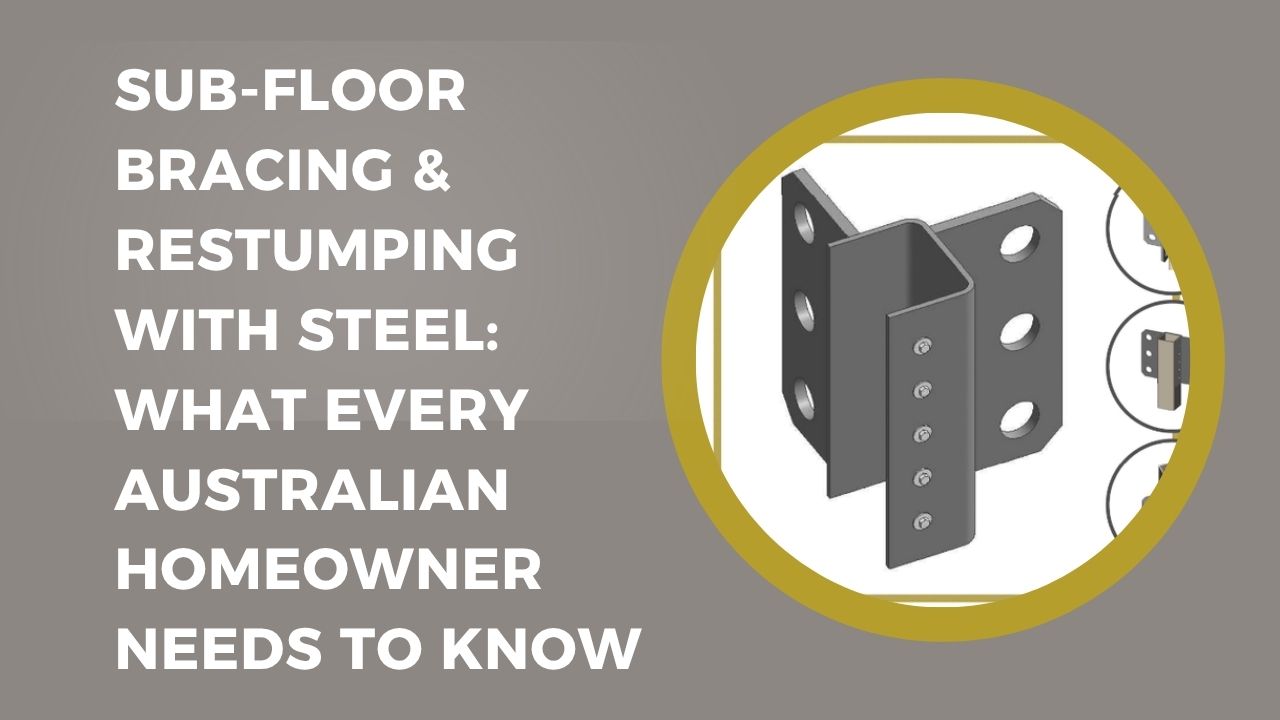
Steel angle bracing cleats are purpose-designed to connect these braces to SHS columns. Available in single-sided, double-sided, 2-way, and 3-way configurations, these cleats slide onto the SHS post and can be secured with tek screws and/or welds depending on load requirements.
2. Steel Rod Bracing
Threaded steel rods (typically M12 or M16) are the most common sub-floor bracing method and are installed diagonally between columns. Rod bracing works primarily in tension and is often used in pairs, forming an X-pattern. Rod bracing cleats connect the rods to the SHS columns, with each cleat able to handle significant tensile loads. These cleats are frequently used in house-raising applications.
3. Timber Cross-Bracing (Traditional)
Older homes often have hardwood or treated pine cross-braces nailed between timber stumps. While this method has served Australian homes for decades, timber bracing degrades over time due to moisture, termites, and settling. If your home has original timber cross-bracing that’s more than 20 years old, it’s worth having it inspected by a structural engineer.
The Restumping Process: What to Expect
If you’re planning a restumping project – whether replacing a few stumps or doing a complete re-stump – here’s a typical workflow:
- Structural assessment – a structural engineer inspects the sub-floor and specifies the required column sizes, footing dimensions, bracing layout, and connection details.
- Council approval – depending on the scope of work, a building permit may be required. Engineer-certified plans are typically needed.
- Temporary support – the house is temporarily supported (jacked and propped) while old stumps are removed.
- New footings – concrete pier footings are poured to the engineer’s specifications.
- Steel column installation – galvanised SHS columns with baseplates are set into or onto the new footings.
- Bearer connections – using top plate cleats or timber beam cleats, the existing or new floor bearers are connected to the steel columns. SHS cleats make this step dramatically faster because they slide to the exact bearer height on each column.
- Bracing installation – steel angle or rod bracing is installed using bracing cleats on the SHS columns.
- Inspection and certification – the completed work is inspected and certified by the engineer and/or building certifier.
How SHS Cleats Simplify Sub-Floor Work
Sub-floor work is physically demanding and often done in tight, uncomfortable spaces. Any product that saves time and reduces complexity is a huge win for builders. Here’s how SHS cleats make a difference:
- No factory welding required – posts and cleats ship separately. No need to handle 3–4 metre welded assemblies in confined sub-floor spaces.
- Slide-on, adjust, fasten – the cleat slides onto the post and can be positioned at any height with one hand, then secured with tek screws in seconds.
- Handles uneven bearer heights – in restumping, bearer levels often vary across the house. Adjustable cleats accommodate this without any modification.
- Purpose-designed bracing cleats – steel angle and rod bracing cleats are specifically engineered for sub-floor bracing applications, with known load capacities.
- Engineering certifications available – SHS Cleats offers engineering design certifications from qualified Australian structural engineers (CPEng, NER, RPEQ), making council approval straightforward.
Signs Your Home May Need Restumping or Bracing Work
Not sure if your sub-floor needs attention? Here are the most common warning signs:
- Bouncy or uneven floors
- Doors or windows that stick, jam, or won’t close properly
- Visible gaps between the floor and skirting boards
- Cracks in plaster walls, especially around door and window frames
- The house visibly leans or sways in strong wind
- Rotting, cracked, or termite-damaged stumps visible under the house
- The home was built before modern bracing standards were introduced
If you notice any of these issues, it’s wise to arrange a sub-floor inspection by a qualified building inspector or structural engineer.
Conclusion
Sub-floor bracing and restumping are essential maintenance and renovation tasks for Australian homes – especially older raised houses. Upgrading to galvanised steel SHS columns with modern cleat connections delivers a longer-lasting, stronger, and more cost-effective result compared to traditional timber methods.
With purpose-designed SHS cleats for bearer connections and bracing, builders can complete sub-floor work faster, with greater precision, and with full engineering certification for council compliance.
Planning a restumping or sub-floor bracing project? Visit shscleats.com.au to explore our range of baseplates, top plate cleats, timber beam cleats, and steel angle bracing cleats. Upload your structural and architectural plans for a custom quote from our engineering team.
