

 Login / Register
  CATEGORIES
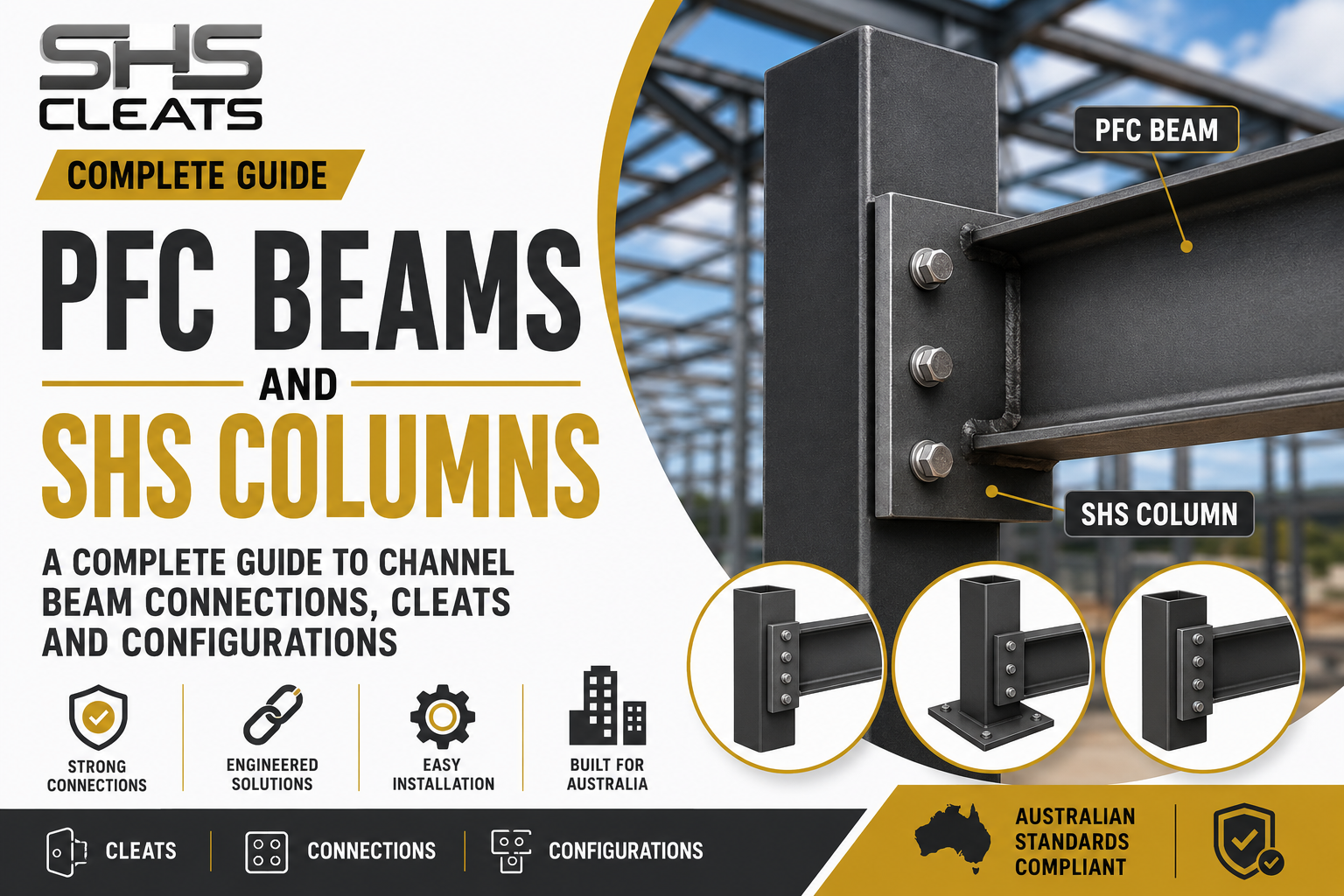
If your structural engineer or building designer has specified a PFC beam for your verandah, carport, elevated deck, or mezzanine floor, you’re working with one of the most versatile structural steel sections available for mid-range residential and commercial spans. But unlike timber, a PFC beam doesn’t just nail or bolt to a post — it needs the right cleat to connect it to an SHS column cleanly and with full engineering compliance.
This guide covers everything: what a PFC beam is, when it’s the right call over timber, how the PFC to SHS column connection works, and how to select the correct SHS PFC beam cleat for each position in your frame.
What is a PFC beam?
PFC stands for Parallel Flange Channel. It’s a steel section with a C-shaped cross-section — two horizontal flanges connected by a vertical web — manufactured so that the flanges are parallel to each other. The open back of the C-shape gives it a flat bearing face, which makes connecting to a column face particularly straightforward.
In Australia, PFC sections are manufactured to AS/NZS 3679.1 and are designated by their depth in millimetres: 150PFC, 180PFC, 200PFC, 230PFC, 250PFC, 300PFC, 380PFC. The larger the number, the deeper the section and the greater its load-carrying capacity over longer spans.
Every standard PFC size has defined section properties — web depth, flange width, wall thickness, and section modulus — set by the Australian standard. These properties let a structural engineer calculate exactly how far a 200PFC can span, how much load it can carry, and what deflection to expect.
When to use a PFC beam instead of timber
PFC beams are specified over timber in several situations:
- Longer spans. Timber has practical limits on clear span before deflection becomes unacceptable. A 200PFC spans significantly further than an equivalent-depth timber bearer, meaning fewer intermediate columns and a more open structure.
- Higher loads. Cyclonic-area roof loads, heavy floor loads in commercial mezzanines, and decks with large tributary areas often exceed what timber can economically carry.
- Termite-prone areas. Steel doesn’t get eaten. In much of coastal Queensland, the Northern Territory, and parts of NSW, specifying PFC beams alongside SHS columns removes the single biggest long-term maintenance risk.
- Consistent, predictable performance. Every piece of 200PFC steel of the same grade has identical section properties — no variation between pieces. When deflection calculations need to be exact, steel delivers what timber cannot guarantee.
- Modern aesthetic. Exposed PFC beams have a clean, industrial-refined look that suits contemporary architectural styles. Many builders now specify PFC beams to be left visible rather than clad.
How the PFC to SHS column connection works
Connecting a PFC beam to an SHS column requires a cleat that captures both the flat column face and the back web of the channel section. The SHS PFC beam cleat sits on the outside face of the SHS column and provides a pocket or bearing point into which the PFC beam end is positioned and then fastened.
The connection transfers the beam’s shear force — the load from everything above — into the column through the cleat and its fasteners. For most residential-to-light-commercial applications using SHS columns from 65×65 to 200×200mm, this is achieved with SHS PFC beam cleats fastened to the column face using Tri-Fixx M8 Series 500 Tek screws, with the PFC web then fastened through the cleat.
No welder is needed on site for this connection. A builder with a drill and the specified Tek screws makes a fully engineered connection in minutes.
Types of SHS PFC beam cleat configurations
2-way inline
Connects two PFC beams running in a straight line through the column — one on each side. This is the configuration for intermediate columns along a continuous beam run, where the beam is essentially passing through the column position.
Corner (left-hand and right-hand)
Connects two PFC beams meeting at a 90° corner at the column. Corner cleats are available in left-hand and right-hand orientations depending on which side of the column each beam arrives from. Essential at every corner column of a rectangular verandah, carport, or deck frame.
3-way intermediate
Connects three PFC beams meeting at a T-junction — two beams running in line and a third arriving at 90°. Used at intermediate columns on a main beam run where a secondary beam branches off at right angles.
Load capacity: what each connection can carry
SHS PFC beam cleats are engineered for higher shear loads than timber beam cleats, reflecting the heavier loads that PFC beams typically carry. Allowable shear capacities are set by the engineering certification for each specific cleat-to-column size combination.
Using Tri-Fixx M8 Series 500 Tek screws to the SHS column face, Tek-only connections achieve substantial shear capacity for most residential applications. For higher-load connections — large commercial spans, cyclonic wind zones, mezzanine floors — adding a 5mm stitch fillet weld alongside the Tek screws increases capacity significantly.
Fastening methods for PFC beam cleats
Tek screws only — for most residential and light commercial projects
The SHS PFC beam cleat is positioned on the column face at the correct height and driven home with the specified number of Tri-Fixx M8 Series 500 Tek screws. The PFC beam end is then inserted into the cleat pocket and fastened through the PFC web. No welder required, achievable by any licensed builder.
Tek screws plus weld — for higher loads
A 5mm stitch fillet weld is added around the cleat-to-column interface after Tek fastening. This combination increases both shear and uplift capacity and is specified in cyclonic wind areas (N4, C2 and above) or where commercial loads exceed the Tek-only capacity.
Weld only — for maximum capacity
Where a licensed welder is on site and maximum connection strength is required, weld-only connections to the SHS column face are an option. Less flexible for on-site height adjustment but achieves the highest possible connection capacity for the column size.
Real project applications
- Large carports, 2-car and 3-car bays — where the span between columns is too great for timber to carry the roof load without excessive deflection
- Commercial verandahs — hospitality venues, retail shopfronts, and commercial office buildings with covered walkways
- Elevated decks on steep slopes — where long column runs on varying heights need a stiff steel beam to maintain span without mid-slope intermediate footings
- Industrial mezzanine floors — where SHS columns carry a steel floor system with PFC floor beams supporting a concrete or steel deck plate
- Communication and equipment platforms — where SHS columns and PFC beam cleats support elevated platforms for telecommunications equipment
Frequently Asked Questions
PFC stands for Parallel Flange Channel. The name describes the cross-section: a C-shaped profile where the two horizontal flanges are parallel to each other. PFC beams are manufactured to AS/NZS 3679.1 in Australia.
Yes. SHS PFC beam cleats are available for 100×100 SHS columns. The allowable shear capacity for each column-size and cleat-type combination is confirmed in the engineering certification documentation. For higher loads, a Tek-plus-weld connection increases capacity for the same column size.
A PFC is an open C-shaped section while an RHS is a closed box. PFC beams have higher shear capacity relative to their weight for long horizontal spans and the open back face makes connecting to column cleats straightforward. For horizontal beams connecting to SHS columns, PFC is typically easier to detail and connect.
Yes. PFC connections to SHS columns in structures requiring a building permit must be engineered. SHS Cleats provides engineering certification for all PFC beam cleat products covering specific column sizes and Tek fastening patterns.
Count the PFC beams meeting at each column and the directions they arrive from. Two beams in a straight line = 2-way inline. Two beams at 90° = corner (left-hand or right-hand). Three beams at a T-junction = 3-way intermediate. Your structural drawings will show the beam layout at each column position.
Specifying PFC beams on SHS columns? Browse the full range of SHS PFC beam cleats — 2-way inline, corner and 3-way intermediate configurations available for all SHS column sizes from 65×65 to 200×200mm. All products are hot-dip galvanised and engineering certified. View the SHS PFC beam cleat range at shscleats.com.au →
