

 Login / Register
  CATEGORIES
Introduction
Planning a verandah, pergola, or deck? Choosing the right steel posts is one of the most important decisions you’ll make. Steel posts – specifically SHS (Square Hollow Section) columns – are the backbone of any outdoor structure. They carry the weight of beams, roofing, and live loads, and they need to last for decades in Australia’s harsh climate.
In this guide, we’ll cover everything you need to know about selecting, sizing, and installing steel posts for outdoor residential structures in Australia – plus how to make strong, efficient beam connections using modern cleat systems.
Why SHS Steel Posts Are the Go-To Choice for Outdoor Structures
SHS (Square Hollow Section) steel posts have become the standard for residential verandahs, pergolas, decks, and carports across Australia. Here’s why builders and homeowners prefer them over timber or circular steel:
- Superior strength-to-weight ratio – SHS posts carry the same loads as heavier alternatives while being lighter and easier to handle
- Clean, modern appearance – the flat faces and sharp edges give a contemporary architectural look, especially when painted
- Easy to connect to – flat faces make it simple to attach beams, brackets, and cleats compared to circular hollow sections
- Termite and rot proof – unlike timber posts, steel doesn’t degrade from insect attack or moisture
- Galvanising options – hot-dip galvanised or Duragal (pre-galvanised) SHS provides excellent corrosion protection for outdoor and coastal environments
- Non-combustible – ideal for bushfire-prone areas (BAL ratings) where timber posts may not be permitted
Common SHS Post Sizes for Residential Projects
Australian SHS steel posts come in standardised metric sizes under AS/NZS 1163. The most common sizes used in residential verandahs, pergolas, and decks are:
| SHS Size (mm) | Wall Thickness | Typical Use | Weight (kg/m) |
| 50 x 50 | 2.0 – 3.0 | Light pergolas, fencing | 2.91 – 4.25 |
| 65 x 65 | 2.0 – 3.0 | Small verandahs, pergolas | 3.87 – 5.62 |
| 75 x 75 | 2.5 – 4.0 | Verandahs, carports | 5.49 – 8.49 |
| 89 x 89 | 2.5 – 3.5 | Decks, larger verandahs | 6.60 – 9.12 |
| 90 x 90 | 2.5 – 5.0 | Standard residential posts | 6.71 – 12.8 |
| 100 x 100 | 3.0 – 6.0 | Heavy-duty verandahs, decks | 8.96 – 16.8 |
| 125 x 125 | 4.0 – 6.0 | Large spans, commercial | 14.9 – 21.7 |
| 150 x 150 | 5.0 – 6.0 | Heavy commercial, multi-storey | 22.2 – 26.4 |
Note: The most popular size for general residential work is 90×90 or 100×100 SHS. Always consult your structural engineer for the correct size based on your span, load, and wind classification.
Steel Post Footings: Getting the Foundation Right
A steel post is only as strong as its footing. For verandahs, pergolas, and decks, there are two primary footing methods:
1. Embedded in Concrete Pier
The most common method: the SHS post (with a baseplate attached) is set into a concrete pier footing. The pier depth and diameter depend on soil conditions and wind loads – typically 450mm diameter and 600–1000mm deep for standard residential work. A galvanised baseplate with chemset bolts or cast-in anchors secures the post.
Pro tip: When embedding steel in concrete, apply a bitumen sealant around the post and baseplate from the ground level down into the footing, and extend it 200mm above ground level on the SHS post to protect against moisture ingress and corrosion.
2. Surface-Mounted on Concrete Slab or Pad
For posts on existing concrete slabs or pads, a baseplate is fastened to the concrete using chemset anchor bolts. This method is common for deck posts and verandahs built onto existing patios. Ensure the baseplate is thick enough (typically 10–16mm) and uses the correct number of anchor bolts for the design loads.
Connecting Beams to Steel Posts: The Critical Joint
Once your steel posts are in place, the next step is attaching your verandah beams, roof beams, or floor bearers. This is where many projects run into problems – getting beam heights precisely right across multiple posts, especially when ground levels vary.
Traditional methods require factory-welding brackets at fixed heights onto the post before delivery. If anything is even slightly off, you’re left with costly rework.
The Modern Solution: SHS Slide-On Cleats
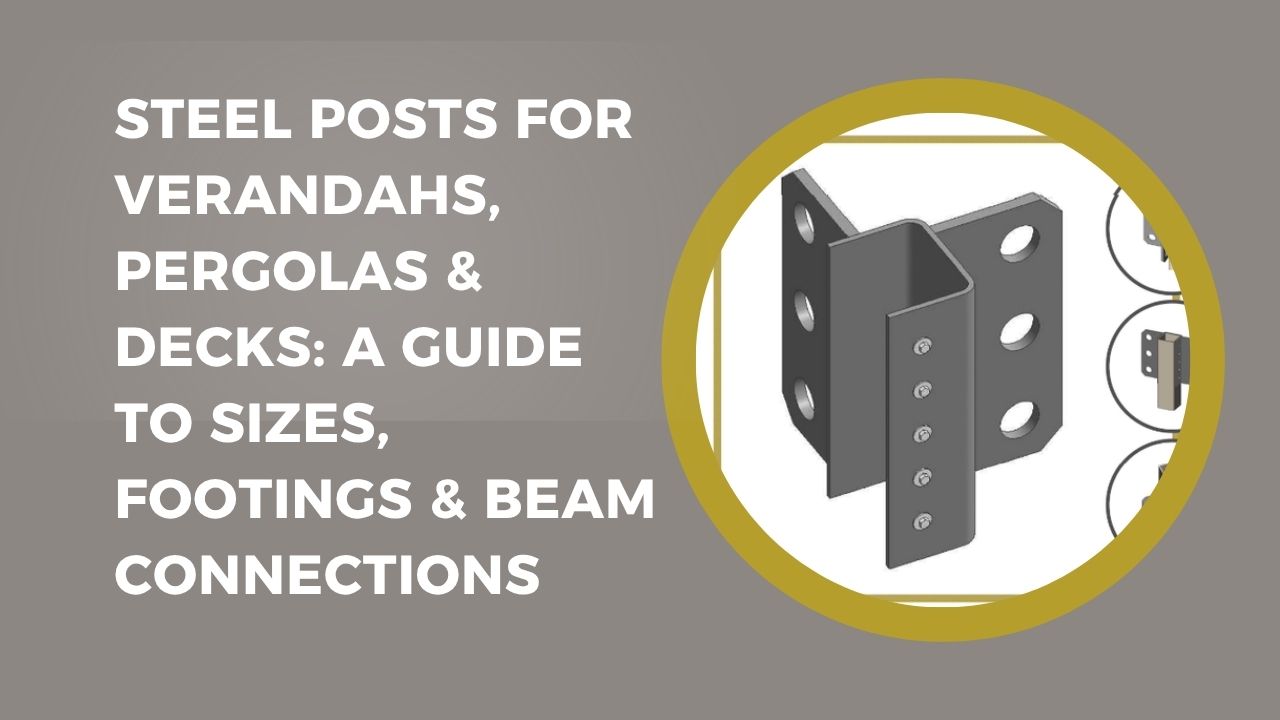
Purpose-designed SHS cleats solve this problem entirely. These patented galvanised steel channel cleats slide onto the SHS column and can be adjusted to the exact beam height on site before being permanently fastened. They come in a wide range of configurations:
- Timber Beam Cleats – for verandah beams, roof beams, and stairway landing bearers (single side, corner, 2-way inline, 3-way intermediate)
- Top Plate Cleats – for supporting timber floor bearers on top of SHS columns (square, corner, intermediate)
- PFC Beam Cleats – for heavier steel channel beams where extra load capacity is needed
- Baseplates – square, rectangular, and corner options for securing posts to concrete
- Bracing Cleats – for sub-floor bracing and high-wind applications
Galvanised vs Painted: Protecting Your Steel Posts
For outdoor structures in Australia, corrosion protection is essential. You have two main options:
Hot-Dip Galvanised (HDG): The gold standard for outdoor steel. The entire post is dipped in molten zinc, creating a thick, self-healing protective layer. Ideal for all outdoor applications, especially coastal areas. Most SHS cleats come pre-galvanised for maximum durability.
Pre-Galvanised (Duragal): The steel sheet is galvanised before forming into the SHS shape. More cost-effective than HDG but with a thinner zinc coating. Suitable for most inland residential applications.
Paint Over Galvanised: Many homeowners paint their galvanised steel posts to match the home’s colour scheme. Monument, Woodland Grey, and Surfmist are popular Colorbond-matching colours. You can paint directly over galvanised surfaces with appropriate etch primers.
Planning Tips for Your Verandah, Pergola, or Deck Project
- Engage a structural engineer early – they’ll specify the correct SHS size, footing design, and connection method for your site’s wind classification and soil conditions.
- Order steel early in your build schedule – custom-fabricated items like SHS cleats have lead times of 1–2 weeks for fabrication, plus shipping.
- Check council requirements – most verandahs and pergolas over a certain size require a building permit and engineer-certified plans.
- Consider bushfire ratings – in BAL-rated areas, steel posts and non-combustible connections may be mandatory.
- Think about future maintenance – galvanised steel with quality cleats requires virtually zero structural maintenance, unlike timber, which needs regular staining and termite treatment.
Conclusion
Steel posts are the foundation of any great verandah, pergola, or deck. By choosing the right SHS size, proper footings, and a modern beam connection system like SHS cleats, you can build an outdoor structure that’s stronger, faster to construct, and built to last in Australia’s tough conditions.
